CreditCards.com
Helping people find the right credit cards
Quick Stats
Roles & Responsibilities
UX/UI Design
Research/competitor analysis
User testing
Prototyping & Interaction design
Increased RPA
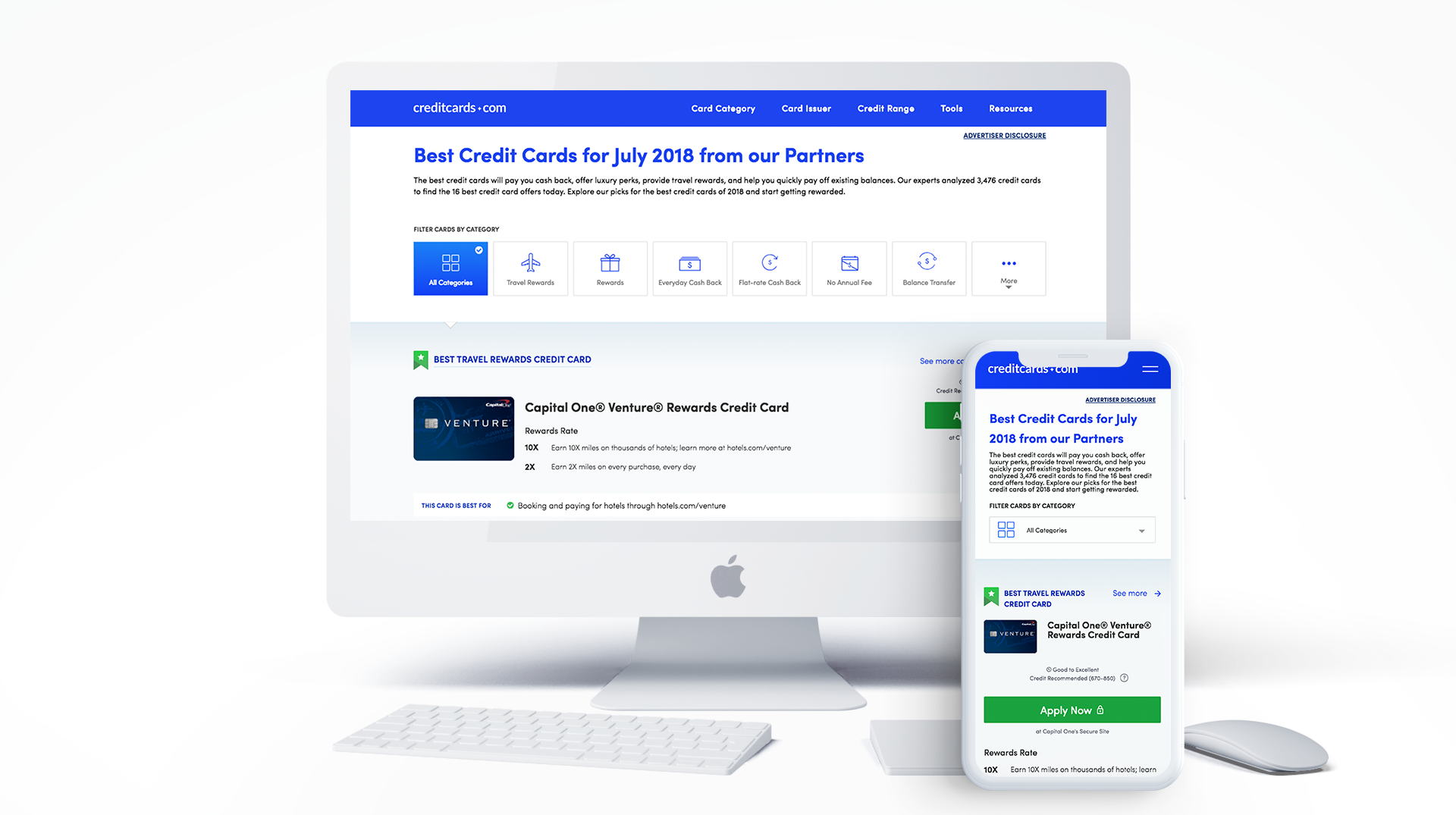
Since the redesign of best cards page, the Revenue per Approval (RPA) is up 6% - This means that users are clicking on cards that are harder to approve, but yield higher bounties. More informed users are applying to cards previously thought to be out of range.
Increased Rev/PV
Revenue per Page View (Rev/PV) is up 5%. In other words, the amount of money made on average for someone who sees the page. This bottom line metric indicates growth in the right direction for business goals and confirms the projections for Q2.
BACKGROUND
The Problem
The Best Cards page is the #2 most viewed page on the site second only to the homepage (averaging around 700k page views in 90 days), however the current user experience is lack luster and not reflective of such a highly ranked page. The engagement of the the page in its current state leaves users uninterested and uniformed, usually dropping off at about the third displayed card. After conducting various user tests, studying the landscape of our market and our competitors, we have come to discover :
Users are unsure of what types of cards (categories) are listed
Users lose engagement after viewing only 20% of the products on the page
Why cards are even listed in the first place. What makes them the “Best”
Consequently, users are also missing key information to help them make informed decisions about what card to get
The current page lacks necessary context to enable users to make informed decisions about applying for a card. There is insufficient context provided to know what product categories are displayed, why each card is "Best" in its category and why a user should apply.
INFORM/STRATEGIZE
Stakeholder Meetings

With the UX team, I sat down with the product manager to discuss how we could improve the page. We discussed goals, problems and questions (as stated above) about the current design. This meeting also discussed business goals and development limitations. Later stakeholder meetings included members of the Customer Experience team to align and coordinate with business goals.
After running a hot jar test on the Best Cards page, we found that users were only viewing the top third of cards displayed. The majority of users did not scroll down to see other cards. In a business of slotting, it makes it difficult for users to find cards that are best for THEM.Realizing that, we had to think of ways to allow for better engagement with the right cards and clarifying the information about each card.
RESEARCH
Market Research
The credit card space has many options. I conducted various studies looking into competitor site features, strengths, weaknesses, color pallettes and more. The high-level result of those findings indicated that CreditCards.com had a lot of catching up to do. Out of the seven main competitors, CreditCards.com ranked lowest in features that customers want.
Below are some of the features that are currently implemented on competitor sites:
Compare 2 (or more) Cards
Save card for later
Contextual Navigation
Contextual Information
User Definition
Filtering
Editorial Content
Granularity
DEFINE
Hypothesis Statment
We believe that improving the best cards experience to help users understand which products are available on the page will help them meet their specific purchasing needs and goals. We will know this to be true when we see a 10% increase in offer clicks (response rate).
CREATE
Collaborative/Pair Design Exercise
We took the top four ideas generated from the stakeholder meeting and went to the whiteboard and sketch books. Together we time-boxed designs and discussed what features and design elements make sense or would be feasible. Below are the ideas we focused on:
Value Prop Enhancement
Editorial Content Relocation
Contextual Navigation
"Best Card for YOU" perspective
Prototyping
Once we were satisfied with a concept, I put together a mid fidelity prototype to get in the hands of some users. Our goal was to get user feedback to validate or disapprove the design.
The prototype featured a contextual navigation to help the user understand which categories were listed on the page and their associated products and to act as a light filtering.
CREATE
TEST
User Testing
Results - the tests validated our design, allowing users to easily find the cards in the categories they preferred. The categories were "simple to use and helpful."
Additional feedback indicated that users wanted the following:
Multiple Category View
Multiple Cards per Category
Compare Feature
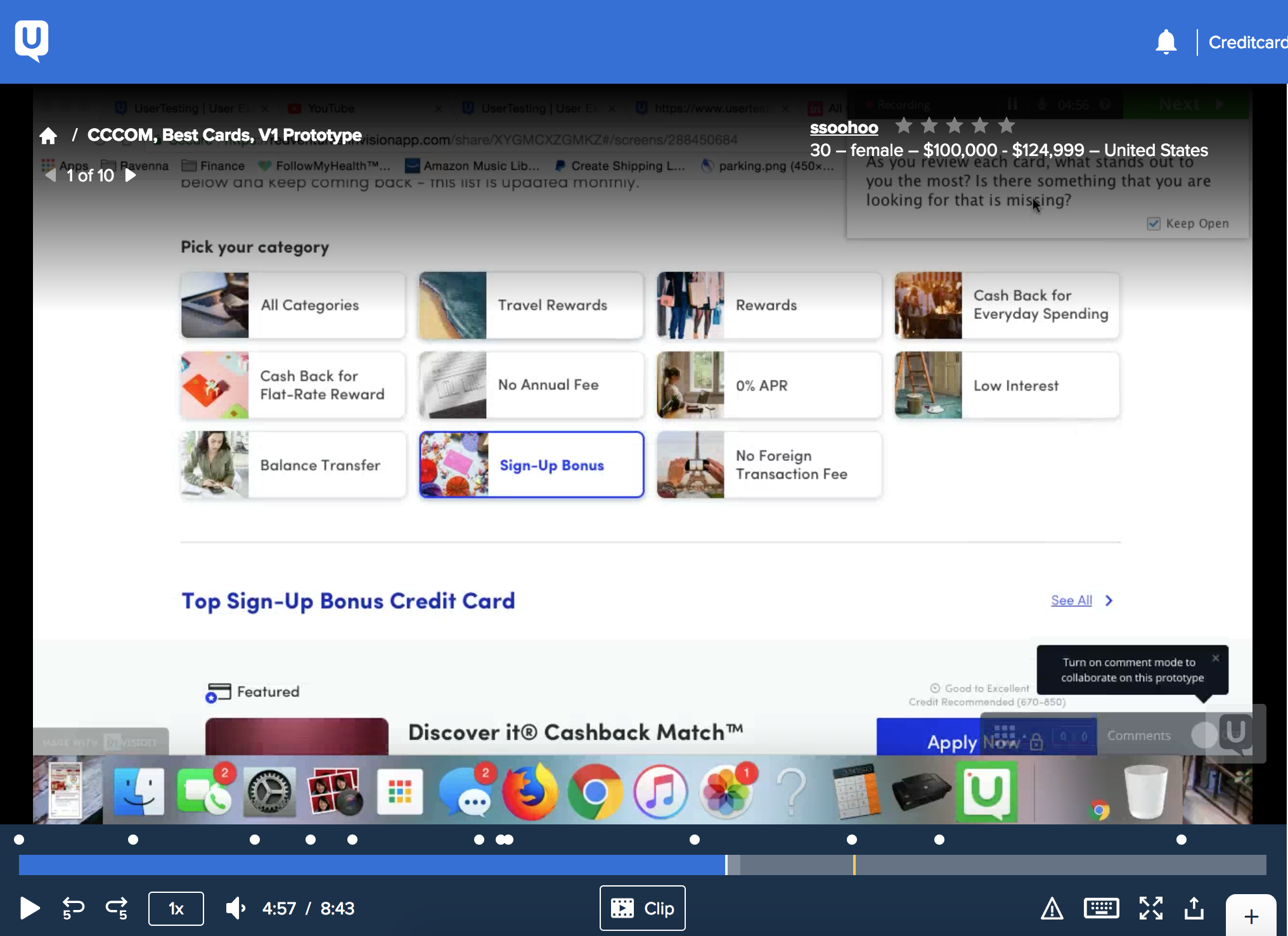
Version 1 validated our design, but we decided to iterate to stay consistent with established patterns. The approach we took was to use the iconography used on the category pages instead of the images. This helped maintain a cohesive experience and would maximize efficiency for dev work. The other iteration to the page was to include more editorial content in more visible and logical locations. This content would inform and instruct, providing users with more understanding of why they should apply.
Contributors to the iteration include:
UX Team
Visual Design Team
Content and Copywriters
Product Manager
Iteration
REFINE/CREATE
High Fidelity Design / Animation Design
I spearheaded the UI animation and collaborated with dev leads to nail down the experience. It was important for us to add engagement and interaction for the users to find the products they desired. The process with the lead dev Rob was awesome. We spent several working sessions refining, brainstorming and collaborating on the interaction.
With my vision and Rob's execution we configured the animation for the following elements:
Category Selection
Category Transition
Accordion expand and collapse
REFINE
SHIP
Design Handoff
Throughout the process I maintained communication with the developers tasked to build the site. Regular desk checks, QA and approvals by the UX team with the developers made for a smooth transition into shipping. I used Zeplin to coordinate with the dev team and house all assets and screens.
What’s next?
We know the work is not done and there is always room for improvement. Due to the limitations and current business goals, there is still much left to do. The next ideas to figure out would be exploring the Compare feature and implementing Multiple Cards displayed per category.
Challenges & Growth
Technical challenges
This project is quite complex, not only when it came to the code base and tech stack, but also coordinating across several teams and various offices country-wide.
Limited developer resources
During a rebuilding and restructuring of a code base, most able hands were on other projects. As a designer, getting my design built often took much longer than I would have liked. This also made it difficult to test and iterate on designs.
Differences in the”definition of done”
There were many discussions about quality of work and deliverables. I took the opportunity to provide instruction and give tutorials to designers on Sketch and InVision to maintain consistent standards and organized files.

Jeff Cushler, Director of Engineering, Bankrate Inc,. CreditCards.com Division.
“Tony has a keen ability to take design models to technical teams and interpret their needs in a fluid and timesaving manner. It has been the due diligence of Tony's communication and savvy that has saved many hours of development for new initiatives for the Creditcards.com site.”